Bali's 2026 Groundwater Crackdown: Why Smart Villa Owners and Hotels Are Switching to Licensed Water Delivery
30 Juli 2026
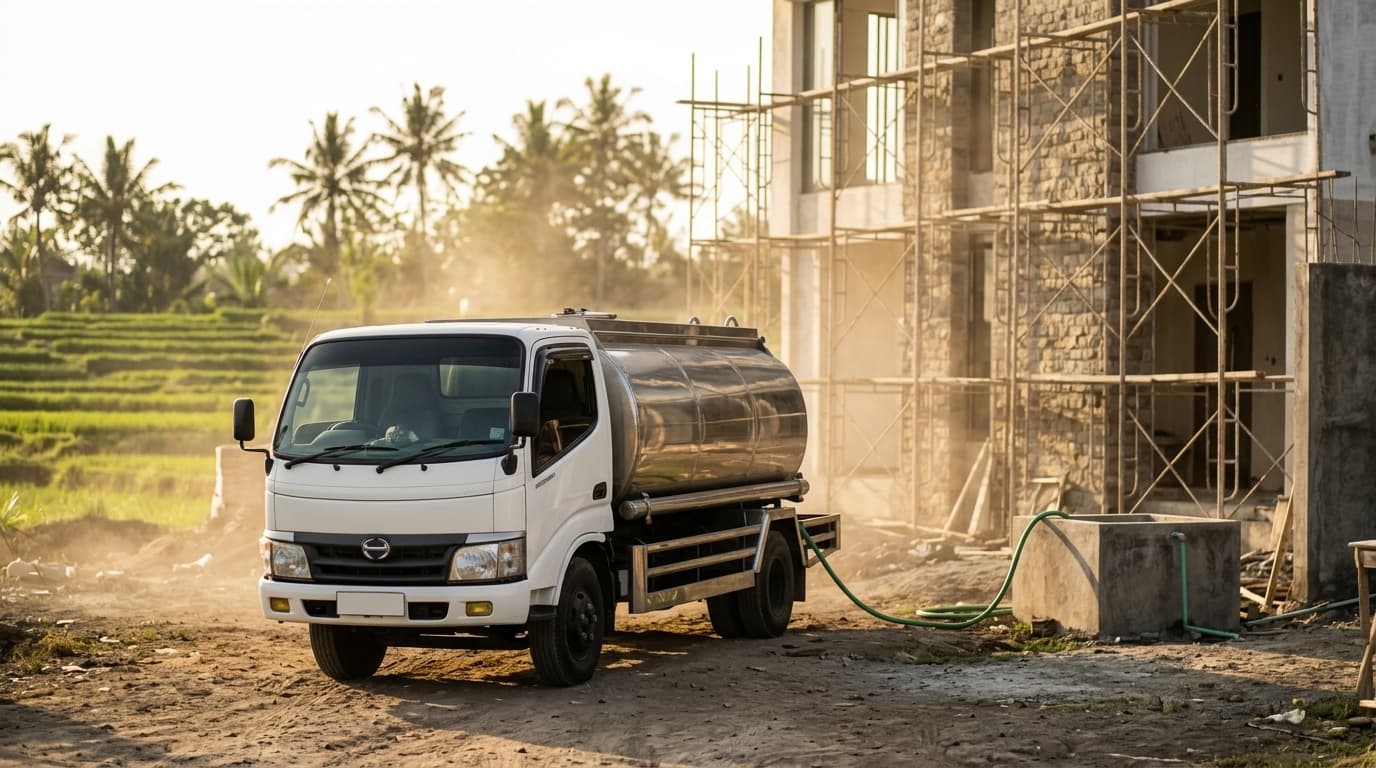
If you own, manage, or are building a villa in South Bali, there's a good chance you've heard whispers about the groundwater situation this year. It's not just talk. Since March 2026, Badung Regency has been actively enforcing a national deadline requiring every commercial well on the island to hold a valid Izin Pengusahaan Air Tanah (SIPA/ABT) — the groundwater extraction permit. Businesses that missed the March 31 cutoff are no longer getting a friendly warning letter. They're facing formal notices, and in some documented cases, police summonses tied to unlicensed wells.
At the same time, Bali's new spatial planning law, Perda No. 4 of 2026 on the Protection of Productive Land, has tightened what can legally happen on land near rice fields, subak irrigation channels, and water catchment areas — some of the very zones where villa wells have historically been drilled without much scrutiny.
Put those two things together, and 2026 is turning into the year Bali's property owners stop treating water as something you simply pump out of the ground and start treating it as something you plan, document, and license — or outsource to someone who already has that covered.
What Actually Changed in 2026
For years, drilling a bore well for a villa, restaurant, or small hotel in Bali was treated almost like installing a water pump — a construction task, not a legal one. That has shifted on two fronts at once.
1. Groundwater permits are now enforced, not just required. Under Law No. 17/2019 on water resources and the more recent Permen ESDM 14/2024, any commercial property extracting groundwater — through a bore, dug well, or pump — needs a SIPA. Badung's government notice in March 2026 made clear that criminal sanctions apply to operators without one, and licensing consultants on the island have reported clients being formally summoned over non-compliant wells. A regularization window existed, but it has now closed for most operators.
2. Zoning enforcement around water-sensitive land has tightened. Perda No. 4/2026 was written to stop the conversion of productive agricultural land and protect Bali's watershed and subak system. Water catchment areas, riverbanks, and irrigation-linked land now carry real legal risk if built on or drilled into without proper clearance — with sanctions that can include demolition orders, not just fines.
Neither rule was designed to target water delivery businesses. They were designed to protect Bali's long-term water table from over-extraction and unregulated development. But the practical effect on villa owners, developers, and hotel operators is the same: drilling your own well is no longer the fast, low-friction option it used to be.
Why This Matters More for New Villas Than Existing Ones
If you're finishing construction on a villa this year, this regulatory shift lands at the worst possible time — right when you need water most, for pool filling, landscaping, curing concrete, and testing plumbing before handover. Applying for a SIPA involves a feasibility review by the Geological Agency, meter installation, and in some cases a monitoring well — a process that can take months, not days.
For property managers overseeing multiple villas, the exposure compounds. A single unlicensed well discovered during an inspection doesn't just risk that one property; it can trigger scrutiny of every property under the same management umbrella.
This is exactly where bulk water delivery has quietly become less of a backup plan and more of a first choice. A licensed water tanker service doesn't require the property owner to hold a groundwater extraction permit at all, because no extraction happens on-site. There's no bore well to register, no monitoring equipment to install, and no risk of a plot straddling a protected water catchment zone that Perda No. 4/2026 now polices closely.
The Practical Shift We're Seeing in South Bali
Talk to enough developers, contractors, and villa managers across Canggu, Uluwatu, Jimbaran, and Seminyak right now, and a pattern comes up again and again: water sourcing has moved from an afterthought to a line item in the project budget, decided before groundbreaking rather than after a well runs dry or a permit application stalls.
A few things are driving that shift alongside the regulatory pressure:
Faster villa handover timelines.
With Bali's luxury rental market as competitive as it is in 2026, developers can't afford a finished villa sitting empty because the pool isn't full or the water pressure isn't tested.
Insurance and investor due diligence.
Golden visa investors and institutional buyers increasingly ask for proof of legal water sourcing before closing a deal, not just proof of land title.
Simple risk math.
A scheduled water delivery costs less in time, legal exposure, and hassle than a drilling permit that might get rejected because the plot sits inside a productive-land buffer zone.
What a Compliant Water Plan Looks Like in 2026
For villa owners, property managers, and developers navigating this new landscape, a few practical steps go a long way:
Check your zoning before you assume you can drill.
A plot in a green zone, water catchment area, or subak-linked area may not be eligible for a groundwater permit at all, regardless of how the land was marketed.
Budget for water delivery during construction
, not just during operation. Pool filling, plastering, and landscaping all demand large volumes of water in short bursts — exactly the kind of demand a scheduled tanker delivery handles well.
Use bulk water delivery as your legal, no-permit-required baseline
, and treat any well as a secondary source that still requires full SIPA compliance if you choose to pursue it.
Keep documentation simple.
A delivery invoice from a licensed supplier is far easier to produce during an inspection than an incomplete groundwater permit application.
How DR Water Supply Fits Into This
We deliver non-potable bulk water by truck across South Bali — for pool filling, tandon and ground tank top-ups, and construction-stage water needs — without requiring you to touch a groundwater permit, drill anything, or risk a plot that falls inside a protected water catchment zone. For villa owners and property managers watching Bali's regulatory environment tighten in real time, that's the whole appeal: predictable, on-demand, and fully outside the compliance headache that now surrounds private wells.
Whether you're finishing a new build in Uluwatu, keeping a Canggu pool topped up through peak season, or managing water logistics across a portfolio of villas, a reliable delivery partner takes one entire legal and operational risk off your plate.
Frequently Asked Questions
Do I still need a groundwater permit if I use water delivery instead of a well? No. If you don't extract groundwater on-site, the SIPA/ABT permit requirement doesn't apply to you. That's a large part of why bulk water delivery has become the simpler compliance path for many villa owners in 2026.
Is it illegal to drill a well on green zone or water catchment land in Bali? Under Perda No. 4/2026, land designated as protected productive land or water catchment area carries strict limits on construction and extraction, with penalties that can include demolition. Zoning should always be verified for the specific plot before drilling or building.
What's the deadline for regularizing an existing well? Badung Regency's enforcement notice set 31 March 2026 as the deadline for commercial groundwater users to hold a valid SIPA. Wells operating without one after that date risk criminal sanctions under Indonesia's water resources law.
How fast can water delivery replace a well during construction? Scheduled tanker delivery can typically be arranged within a day or two of first contact, compared to a groundwater permit process that can take months to clear feasibility review.
Butuh Air Bersih Berkualitas?
Pesan sekarang melalui WhatsApp dan dapatkan layanan pengiriman air bersih terbaik di Bali
Order via WhatsApp